What is the difference between interim managers and consultants?
Anyone looking for external expertise in the SME sector often thinks first of traditional consulting. In practice, however, it is not the concept that separates the wheat from the chaff, but its realization. The decisive difference lies in the responsibility: while consultants point the way, interim managers actively pave the way. There is often an important phase between the development of a strategy and its implementation in day-to-day business. It requires decisions to be made and measures to be implemented consistently. This is precisely where misunderstandings arise, as well as expectations that traditional consulting cannot always fulfill. The difference between a consultant and an interim manager is therefore far more than a conceptual subtlety: it determines whether ideas remain theoretical or are translated into measurable results. And this is precisely why this question deserves special attention.
Table of contents
Where consulting ends and management begins
Traditional consulting approaches are primarily designed for input: They structure data and deliver well-founded strategy papers. In doing so, they create the indispensable basis for management decisions. However, their work ends where the concept stands. The operational responsibility for the success of the measures remains with the company. The consultant provides the knowledge – the burden of implementation is borne by the organization.
Interim managers not only deliver ideas, they also implement them. They take on a central management function for a limited period of time and ensure a clear direction in day-to-day business. They ensure that necessary changes are not only planned but also consistently implemented. Your strength lies in the combination of experience, speed and an objective perspective. They manage processes, lead teams and accompany the organization through challenging phases. They remain in the company until structures are stable, processes work and the desired results have been achieved.
Role
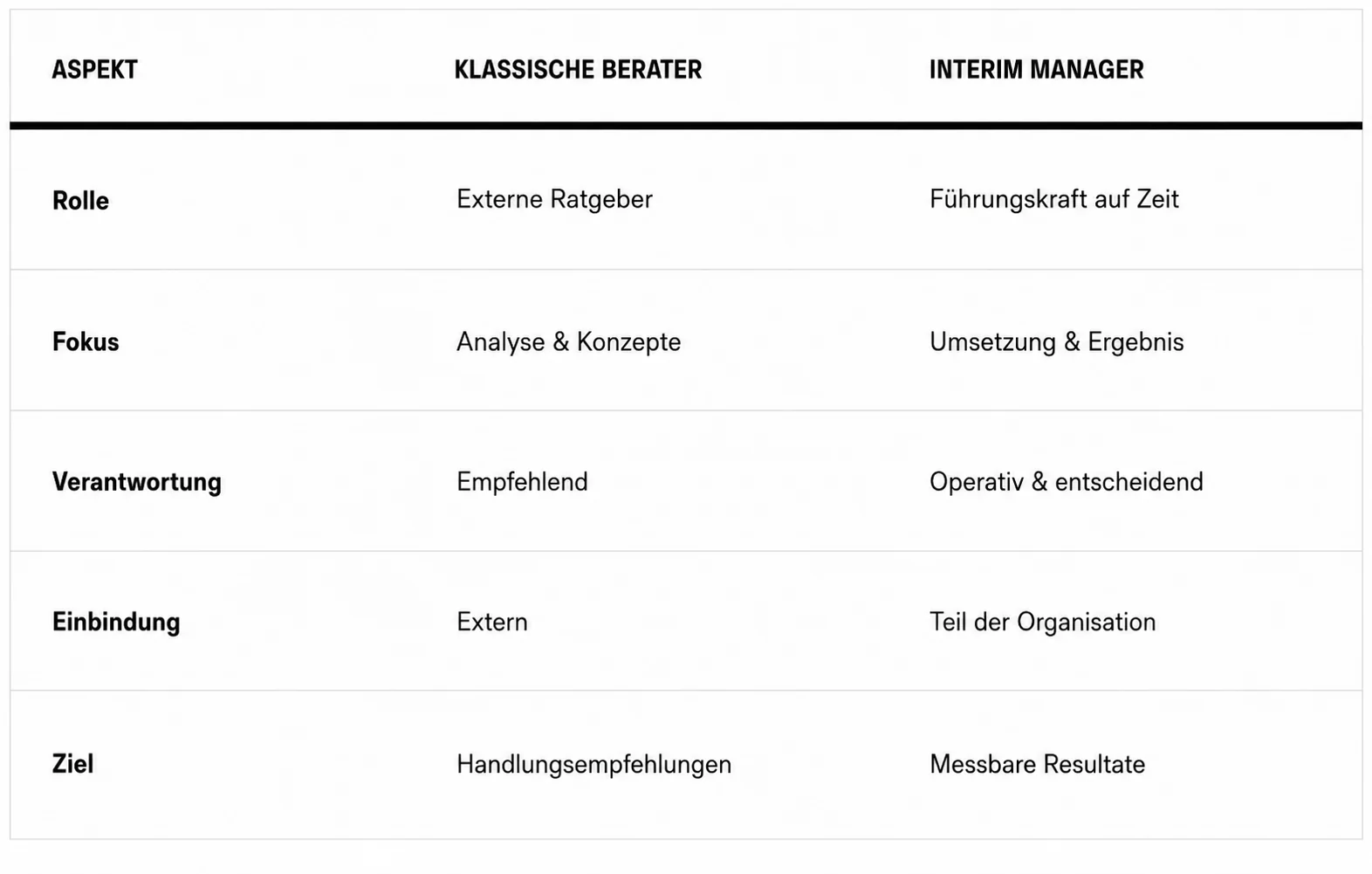
A classic consultant acts as an external sparring partner: they analyze, answer questions and make recommendations. Their role is deliberately kept outside the organization and is geared towards input. An interim manager, on the other hand, takes on a clearly defined management position and becomes part of the company structure for a period of time. He leads employees, prioritizes tasks and is responsible for day-to-day management.
Focus
Consultants focus primarily on identifying problems, developing strategies and presenting options. Their contribution often ends once the new approach is in place. Interim managers focus on implementing the necessary steps. They translate plans into tangible processes, remove structural obstacles and ensure visible improvements in day-to-day business.
Responsibility
A consultant gives advice, but is not responsible for its success. Whether and how something is implemented is up to the company. In contrast, interim managers take over the operational management: they set the tone and are responsible for the results achieved. This creates commitment and makes progress traceable.
Integration
Consultants deliberately remain distanced in their role and typically work on a project-related basis from the outside. They interact selectively, but not as part of the organization. Interim managers, on the other hand, are directly involved – in the organization chart, in meetings, in everyday life. They are close to the team, are familiar with internal dynamics and can react quickly.
Goal
Consultants primarily provide recommendations for action that serve as the basis for the next steps. Their work provides the common thread, but requires additional resources for implementation. Interim managers pursue a different goal: concrete, measurable results. They close the gap between concept and reality so that new ideas actually have an impact.
Practical examples in the SME sector
Theory and practice usually diverge in SMEs where there is a lack of internal resources for change. This is where the difference between advice and action becomes concrete: the interim manager not only provides the ‘how’ but, as an active part of the organization, also ensures that the ‘what’ actually happens. The following scenarios make this particularly clear – they are typical of medium-sized companies and show how strongly the two roles differ from one another.

Turnaround
Speed is essential in challenging business situations. Consultants analyze the economic situation, identify cost drivers and recommend further actions. Their work creates transparency, but the transfer of concepts into day-to-day business usually takes place internally.
In this situation, an interim manager takes on an operational management role, often even at C-level. They stabilize the organization, ensure liquidity and make decisions that cannot be postponed. They manage teams, set priorities and initiate important changes. For SMEs, this means less risk, more speed and a higher probability of success.

Restructuring
Restructuring is a tour de force on three levels: It requires new structures, the right team and highly efficient processes. Consultants show which paths could be more efficient, where costs arise and which options are available. They deliver important analyses and helpful models that provide orientation.
Interim managers, on the other hand, guarantee the realization of these changes. They rearrange the organizational structure, assume responsibility in the affected departments and guide the workforce safely through the dynamics of change. This also includes communicating priorities transparently, reducing resistance and ensuring that new routines work on a day-to-day basis. The end result is not just a draft strategy, but a company that is actually realigned.

Scaling and growth
Growth offers immense opportunities, but often pushes the existing process landscape to its limits. Consultants develop market entry strategies, analyze potentials and describe possible paths. They provide important food for thought on how a company can position itself in a pioneering way.
Interim managers transform these theoretical considerations into real-life practice in day-to-day business. They establish structures, teams and responsibilities, implement key performance indicator systems and professionalize processes. They often take over the management of new units, create clear interfaces and ensure that the organization can support growth without losing stability. This creates a resilient foundation for new ways of working that work on a day-to-day basis.

Succession, transition and management vacancies
Succession and transition situations are among the most sensitive phases in SMEs. Consultants often provide conceptual support for such processes, develop handover models or assist with strategic realignment. They provide important impetus for the future direction without becoming part of the operational management themselves.
Interim managers guarantee the organization’s unrestricted ability to act in these phases. They fill critical management positions ad interim and bring calm to ongoing operations. In doing so, they create a reliable foundation for cooperation with employees, customers and partners. At the same time, they prepare the organization for the permanent succession and ensure that the transition runs smoothly – without any loss of productivity or management vacancies.
Why we can do both and focus on implementation
Our expertise combines reliable analyses with the necessary confidence in day-to-day management. We understand elementary correlations, analyze complex situations and develop viable solutions. At the same time, we take over the implementation where the course has to be maintained on a day-to-day basis and changes in the company have to have a tangible impact. This dual competence allows us not only to make recommendations, but also to implement them under real conditions.
Our work is consistently hands-on. We get involved in day-to-day business, work closely with managers and teams and actively manage operational processes. Instead of handing over concepts, we remain in charge until structures are in place, workflows are functioning and progress is measurable. For medium-sized companies, this means reliability, speed and solutions that do not remain theoretical, but are convincing in day-to-day operations.

The ideal combination of analysis and implementation power
Whether turnaround, restructuring or growth: clever strategies form the foundation, but only their consistent implementation ensures continued existence. We position ourselves at precisely this interface. We combine analytical precision with proven leadership sovereignty. The result is a dynamic that makes the decisive difference in the SME sector: with us, visions do not remain theoretical – we put them directly into practice in day-to-day business. We take the team with us on site and firmly anchor new processes in the corporate culture. In this way, we create a foundation that lasts far beyond our assignment.